
Microsoft has announced Project Zenith, a ready-to-code, distraction-free Windows experience to help developers build apps, AI tools, and agents faster. The experience combines a preconfigured Windows setup with powerful hardware that can handle demanding AI tasks on high-end PCs. In this article, we explain what Project Zenith is, what it includes, and how it supports software development and local AI workloads.
Project Zenith from Microsoft explained
Project Zenith is essentially a preconfigured Windows experience for developers. Rather than requiring developers to spend time installing tools and changing Windows settings after setting up a new PC, Project Zenith provides a preconfigured development environment from the start.
Project Zenith focuses on a ready-to-code Windows setup
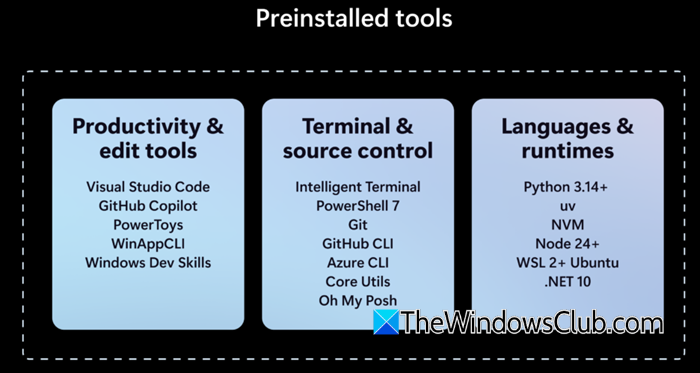
The experience includes a curated selection of development tools covering programming languages and runtimes, source control, and productivity. Windows Terminal and Visual Studio Code are pinned to the taskbar for immediate access.
Windows itself is also configured with developer-focused defaults. File Explorer shows file extensions, hidden files, the full path in the title bar, and the details pane. Long-path support is enabled, while recently used files and folders and sync-provider tips are disabled to reduce clutter.
Microsoft has also configured Search and Start for development workflows. Command Palette is enabled in both, while Start menu tips and account notifications are turned off to reduce distractions.
The company says Project Zenith is not intended to lock developers into a particular workflow. Developers can still customize the PC and install whatever applications, programming languages, and tools they need.
Local AI is a major part of Project Zenith
According to Microsoft, Project Zenith devices can run 30-billion-parameter-plus models locally and without metered usage. This can help reduce reliance on metered cloud tokens for workloads that the PC can handle itself.
The hardware requirements are significant. A Project Zenith device needs at least 64 GB of unified memory and 250 GB/s of memory bandwidth. These specifications are particularly relevant to local AI workloads because unified memory can be shared across the system’s processing components.
Project Zenith also builds on Windows’ agent security work
Microsoft says Project Zenith devices will also benefit from platform capabilities including OS-enforced identity and Microsoft Execution Containers (MXC), which Microsoft introduced as part of its efforts to provide a secure foundation for agentic applications. These capabilities are intended to help developers build and run agents in a more controlled environment.
The announcement also builds on Microsoft’s continued integration of Windows Subsystem for Linux (WSL). Microsoft says WSL has become an important part of Windows development, while WSL containers provide a built-in way to create, run, and interact with Linux containers directly on Windows.
AMD Ryzen AI Halo gets Project Zenith first
Project Zenith will initially be available with AMD’s Ryzen AI Halo. Microsoft says additional devices from its OEM and silicon partners will arrive in the coming months.
For developers, the bigger change is therefore not a new Windows edition but a standardized starting point that combines suitable hardware with development-focused Windows configuration and tools. For more information, read Microsoft’s official blog post.
